What Is the UV Index in Aruba?
Aruba’s UV Index reaches 11+ (extreme) year-round due to its location 12 degrees north of the equator. This means unprotected skin can burn in under 15 minutes. The UV Index measures sunburn-producing ultraviolet radiation strength at a specific time and place, making it a critical tool for gauging sun exposure risks on the island.
Understanding the UV Index Scale and Intensity
The UV index scale ranges from 0 to 11+. Aruba consistently hits 11+ (extreme) while northern climates peak at 6-7 in summer. At extreme levels, skin damage occurs in 10-15 minutes without protection.
Understanding these numbers is vital for sun safety:
- 0 to 2 (Low): minimal danger for the average person,
- 3 to 5 (Moderate): little risk of harm from unprotected sun exposure,
- 6 to 7 (High): high risk of harm from unprotected sun exposure,
- 8 to 10 (Very High): very high risk of harm; extra precautions are needed,
- 11+ (Extreme): extreme risk of harm from unprotected sun exposure.
Why Aruba Experiences Extreme UV Radiation Levels
Aruba’s position at 12 degrees north latitude creates a shorter atmospheric path for UV rays—30-40% less atmosphere to penetrate compared to mid-latitude regions. This geographical position results in consistently high UV radiation intensity. The sun stays nearly overhead year-round, allowing 95% of UVA and UVB rays to reach ground level versus 60-70% in temperate zones. This is why skin protection is not just recommended but essential for every visitor.
When Is the UV Risk Highest in Aruba?
UV levels reach extreme (11+) between 10:00 AM and 4:00 PM daily in Aruba, with peak intensity at solar noon (12:30-1:30 PM). During this 6-hour window, you can sustain severe burns in 10-15 minutes. Understanding the temporal patterns of UV radiation helps you plan your day to minimize danger while still enjoying the island.
Identifying Peak UV Hours During the Day
The peak UV hours in Aruba occur between 10:00 AM and 4:00 PM, with UV Index values of 11-13. Outside this window, levels drop to 6-8 (high) but still require protection. It is during these hours that the time of day UV peak hits levels of 11 or higher.
- Early Morning (Before 10 AM): UV Index 4-6; safer for 30-45 minute outdoor sessions,
- Midday (10 AM – 2 PM): UV Index 11-13; seek shade or stay indoors,
- Late Afternoon (After 4 PM): UV Index drops to 3-5 within 60-90 minutes of sunset.
Seasonal Variations in UV Radiation Intensity
Aruba’s UV Index varies by only 1-2 points year-round, staying between 10-13 in all months. December through March averages 11, while June through August peaks at 12-13. The UV index remains high year-round, meaning you cannot let your guard down even if you visit in December or January.
While there may be slight fluctuations, the UV radiation levels are consistently strong enough to cause burns within minutes throughout all twelve months. This consistency requires a permanent adherence to sun protection measures regardless of the season.
How to Monitor the Daily UV Index Forecast
Check UV forecasts every morning using weather apps that provide hourly readings. Most smartphones show real-time UV index forecast data with 85-90% accuracy for Aruba. You should check the forecast every morning before leaving your hotel.
| Method | Description |
|---|---|
| Weather Apps | AccuWeather and Weather Channel update UV data every 2-3 hours with hourly graphs. |
| Local Reports | Hotel lobbies display daily UV forecasts; most predict 11+ for midday hours. |
| Wearable Tech | Smartwatches with UV sensors alert when exposure exceeds 10-minute safe thresholds. |
What Are the Health Risks of High UV Exposure?
Aruba’s extreme UV causes first-degree burns in 10-15 minutes and increases melanoma risk by 50-80% with repeated unprotected exposure. Immediate effects include painful burns and heat exhaustion, while long-term damage includes premature aging and skin cancer. Awareness of the health risks of UV is the first step in prevention.
Immediate Effects: Sunburn and Heat Exhaustion
At UV Index 11+, fair skin burns in 10 minutes, medium skin in 15 minutes. Second-degree burns with blistering occur after 30-45 minutes of continuous exposure. Symptoms include red, painful skin that feels hot to the touch, and in severe cases, blistering.
Beyond the skin, high UV and heat often lead to heat exhaustion:
- symptoms: dizziness, nausea, core temperature above 38°C (100.4°F), and profuse sweating,
- cause: fluid loss of 2-3 liters per day combined with 32-35°C (90-95°F) heat index,
- action: move to air conditioning below 24°C (75°F) and drink 500ml water immediately.
Long-Term Risks: Skin Damage and Skin Cancer Prevention
Cumulative UV exposure of 50-100 hours in Aruba-level conditions causes visible photoaging: leathery texture, age spots appearing 5-10 years earlier, and wrinkles deepening by 30-40%. This manifests as permanent skin damage.
More critically, skin cancer prevention is the primary reason to respect the sun. Each blistering sunburn doubles melanoma risk; 5+ burns increase lifetime risk by 80% according to Skin Cancer Foundation 2024 data. Consistent use of sun protection strategies is the only effective way to mitigate this long-term threat.
How to Protect Yourself Effectively in Aruba
Use SPF 50+ broad-spectrum sunscreen (reapply every 90-120 minutes), UPF 50+ clothing, and seek shade during 10 AM-4 PM when UV reaches 11+. Combining 3-4 protection methods reduces burn risk by 95-98%. Relying on just one method is often insufficient against the tropical sun; a multi-layered strategy of UV protection is best.
Selecting the Best Sunscreen: SPF Rating and Mineral Options
For Aruba’s UV Index 11+, use SPF 50+ broad-spectrum sunscreen that blocks 98% of UVB rays. SPF 30 blocks 97% but requires reapplication every 60-90 minutes versus 90-120 minutes for SPF 50+. The SPF rating is the most important factor.
Mineral sunscreen containing 20-25% zinc oxide or titanium dioxide is often preferred:
- effectiveness: physical barrier reflects 95-98% of UV rays immediately upon application,
- environment: reef-safe formulas protect coral; chemical filters damage 75% of Caribbean reefs,
- sensitivity: causes allergic reactions in under 5% of users versus 15-20% for chemical filters.
Proper Sunscreen Application and Reapplication Techniques
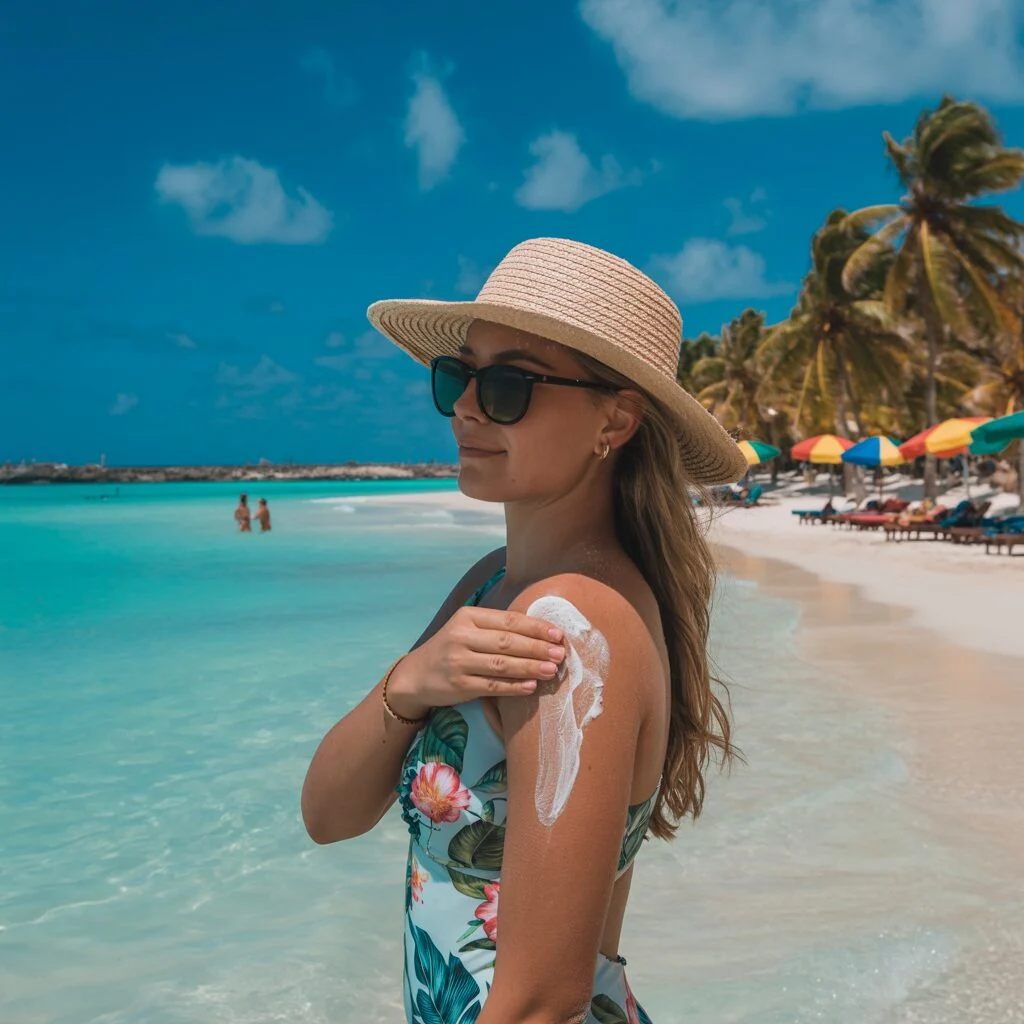
Apply 30ml (1 ounce/shot glass) for full body coverage 15-30 minutes before sun exposure. Most people use 25-50% of the needed amount, reducing SPF 50 to effective SPF 15-25. Sunscreen application must be thorough to be effective.
Reapplication of sunscreen is just as critical as the first layer:
- apply the first layer 15 to 30 minutes before going outside to allow absorption,
- reapply every 90-120 minutes for SPF 50+, every 60-90 minutes for SPF 30,
- reapply within 15-20 minutes after swimming, heavy sweating, or towel drying.
Wearing Protective Clothing and Sun Hats
UPF 50+ clothing blocks 98% of UV rays without reapplication, providing 8-10 hours of continuous protection. Long-sleeve shirts and pants reduce exposed skin area by 60-70%. Protective clothing offers consistent coverage that doesn’t wash off.
A wide-brimmed sun hat with 7-10cm (3-4 inch) brim blocks 70% of facial UV exposure and protects ears and neck:
- style: 7-10cm (3-4 inch) brim provides optimal face, ear, and neck coverage,
- material: tightly woven fabrics (UPF 50+) block 98% of rays versus 50-60% for straw,
- coverage: ensure it shades the back of your neck, which receives 40% more UV than face.
Using Sunglasses to Prevent Eye Damage
UV400 sunglasses block 99-100% of UVA and UVB rays, preventing cataracts (risk increases 60% with chronic exposure) and macular degeneration. Wraparound styles block 95% of peripheral rays versus 70% for standard frames. Sunglasses are a non-negotiable accessory.
Ensure your eyewear offers 100% UV protection (often labeled as UV400). Wraparound styles are particularly effective because they block peripheral rays that can enter from the sides.
Strategies for Seeking Shade and Limiting Exposure
Palapas (thatched umbrellas) reduce UV exposure by 75-85% but still require sunscreen for reflected rays from sand and water. Plan indoor activities between 10 AM-2 PM when UV peaks at 12-13. Shade seeking is one of the simplest and most effective ways to reduce UV intake.
If you must be outside between 10 AM and 2 PM, stay under UPF-rated shade structures. Plan indoor activities (shopping, museums, air-conditioned restaurants) during this 4-hour window to avoid 60-70% of daily UV exposure and naturally avoid the sun health risks.
Sun Safety Tips for Outdoor Activities
Wear UPF 50+ rash guards while snorkeling (water reflects 10-25% additional UV), reapply waterproof SPF 50+ every 60-90 minutes, and drink 3-4 liters of water daily in Aruba’s heat. These outdoor activities increase your vulnerability to the sun, requiring specific sun safety tips.
Managing Sun Exposure While Swimming and Snorkeling
Water reflects 10-25% of UV rays upward, increasing facial and shoulder exposure by 15-30%. Water temperature (26-28°C/79-82°F) masks burn sensation until 30-60 minutes after damage occurs. Furthermore, water reflects UV rays, increasing the intensity of exposure on your face and shoulders.
To manage sunburn risk while snorkeling:
- wear UPF 50+ rash guard or swim shirt blocking 98% of rays,
- apply water-resistant SPF 50+ to back of legs, neck, and ears (reapply every 60-90 minutes),
- limit continuous snorkeling to 30-45 minutes; take 15-minute shade breaks.
Importance of Hydration in the Sun
Aruba’s 27-32°C (80-90°F) heat with 70-80% humidity causes 2-3 liters of sweat loss per day. Dehydration reduces skin’s UV resistance by 20-30% and increases heat stroke risk 3-fold. Hydration in sun is vital for maintaining your body’s ability to regulate temperature.
Drink 250-500ml (8-16 oz) water every 30-60 minutes during outdoor activity, totaling 3-4 liters daily. Avoid excessive alcohol (dehydrates 40% faster) or caffeine (increases fluid loss by 15-20%) during 10 AM-4 PM peak heat, as these substances can accelerate dehydration and increase susceptibility to heat stroke.
Does Cloud Cover Reduce UV Radiation in Aruba?
Light clouds allow 70-90% of UV rays to penetrate; you can still burn in 15-20 minutes on overcast days. Scattered clouds can increase UV by 10-25% through reflection and scattering effects. A common misconception is that clouds block UV rays.
Do not be fooled by an overcast day. The “hazy” sun can still cause severe burns because UV rays scatter and reflect off clouds, sometimes creating 10-25% higher exposure than clear skies. You must maintain full sun protection measures (SPF 50+, UPF clothing, shade) even when the sky looks gray or cloudy.
How to Treat Sunburn and Skin Damage
For first-degree burns: apply aloe vera gel every 2-3 hours, take 400-600mg ibuprofen every 6-8 hours, and drink 3-4 liters of water daily. Seek medical care if blistering covers over 20% of body or fever exceeds 38.5°C (101°F). Immediate treatment is necessary to stop further skin damage and alleviate pain.
If you notice signs of a burn, get out of the sun immediately:
- cool down: take 10-15 minute cool (not cold) shower at 20-24°C (68-75°F) or apply cool compresses every 2-3 hours,
- moisturize: apply 100% aloe vera gel (Aruba produces pharmaceutical-grade aloe) 3-4 times daily to reduce healing time by 30-40%,
- hydrate: drink 500ml (16 oz) water immediately, then 250ml (8 oz) every hour for 6-8 hours,
- medicate: take 400-600mg ibuprofen every 6-8 hours to reduce inflammation by 40-50% and pain by 60-70%.