I will explain the essential financial logistics you need to master before landing on the One Happy Island. Use credit cards (Visa/Mastercard) for hotels and large purchases to avoid 3% foreign transaction fees, but carry $100-200 cash in small bills ($1, $5, $10) for taxis, buses ($2.60 fare), and street vendors who don’t accept cards. The USD-AWG exchange rate is fixed at 1:1.75, and ATM fees run $3-5 per withdrawal.
Cash vs Card in Aruba: Which Is the Better Option?
Use cards for transactions over $50 at hotels and major retailers; carry cash for taxis (card-free), buses ($2.60 exact change required), and street vendors. The optimal split: 70% card payments for tracking and points, 30% cash ($100-200 total) in denominations of $1, $5, and $10 bills for daily small transactions.
What Currency Is Used in Aruba?
Aruba operates on a dual-currency system with the Aruban Florin (AWG) as official currency and US Dollars accepted everywhere at a fixed 1:1.75 exchange rate. You can complete your entire trip using only USD without exchanging money.
Can You Use US Dollars in Aruba?
US Dollars are accepted at 95% of businesses including all hotels, restaurants, casinos, and grocery stores. Carry small denominations ($1, $5, $10) as vendors often cannot break $50 or $100 bills and will return change in AWG.
What Is the Aruban Florin (AWG)?
The Aruban Florin (AWG) is the official currency available in square-shaped 50-cent coins, round coins, and colorful banknotes. You don’t need Florins for your trip, but having 20-50 AWG helps at local “boticas” (pharmacies) where prices list primarily in AWG.
What Is the Exchange Rate Between USD and AWG?
The exchange rate is pegged and fixed:
- 1 USD = 1.75 AWG for cash transactions at stores,
- 1 USD = 1.80 AWG when buying Florins at banks.
To convert AWG prices to USD, divide by 1.75 (or roughly by 2 for quick estimates).
Should You Exchange Money Before Visiting Aruba?
No exchange needed before arrival. US Dollars work everywhere from the moment you land. Exchanging at home banks incurs poor rates and 3-5% fees. Get Aruban Florins from island ATMs or as change from USD purchases if desired.
Are Credit and Debit Cards Widely Accepted in Aruba?
Cards work at 80-90% of tourist-zone businesses with modern POS systems. Visa and Mastercard have near-universal acceptance; American Express works at 60% of locations; Discover at 40%. Small local businesses prefer cash to avoid 2-3% processing fees.
Which Credit Card Brands Are Accepted?
Visa and Mastercard are accepted at 95% of establishments. American Express works at high-end hotels and luxury retailers but faces rejection at 40% of small restaurants and supermarkets due to higher merchant fees. Carry Visa or Mastercard as primary payment method.
Can You Use Debit Cards for Purchases?
Debit cards linked to Visa, Mastercard, Maestro, or Cirrus networks work for purchases with immediate fund deduction. Notify your bank 48 hours before travel to prevent fraud blocks on foreign transactions.
Are Contactless and Mobile Payments Available?
Contactless payments (Apple Pay, Google Pay, tap-to-pay cards) work at 60-70% of tourist-area terminals installed after 2020. Older terminals at gas stations and small boutiques require chip insertion or card swipe.
Do Local Businesses Prefer Cash or Card?
Small local businesses prefer cash to avoid 2-3% credit card processing fees. This includes independent eateries, small souvenir shops, and local bakeries outside main tourist strips. Cash payments may yield 5-10% better prices at flea markets.
When Is Cash Necessary in Aruba?
Cash is mandatory for taxis (95% card-free), public buses ($2.60 exact change), street vendors (100% cash-only), and some gas stations. Keep $50-100 in small bills ($1, $5, $10) for these daily transactions.
Do Taxis in Aruba Accept Credit Cards?
95% of taxis operate cash-only with fixed zone-based fares ranging $15-45 depending on distance. Have US Dollars or Aruban Florins ready; only specialized airport shuttle services accept cards.
Payment Methods for Street Vendors and Local Markets
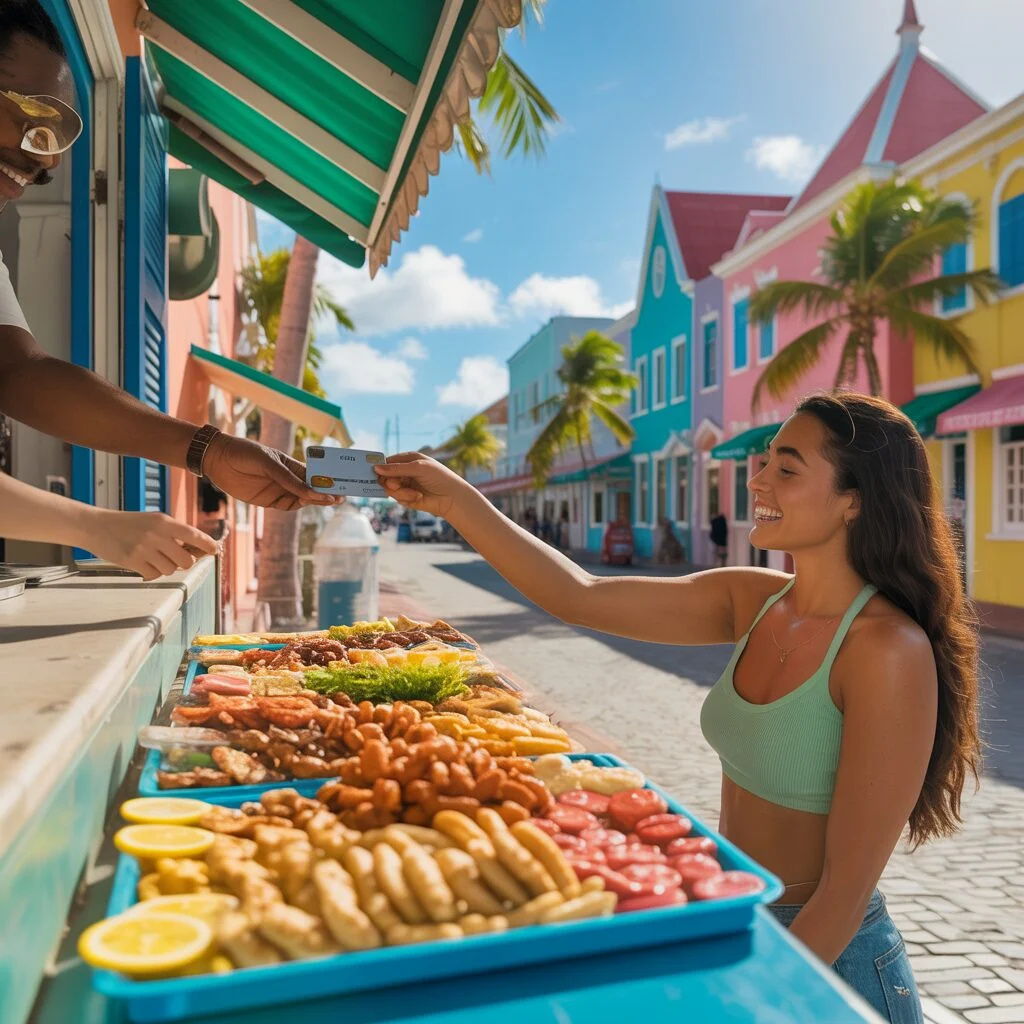
Flea markets in Oranjestad and beachside craft vendors accept only cash due to lack of electricity and Wi-Fi for card terminals. Carry $1, $5, and $10 bills; vendors cannot break $50 or $100 bills and will return change in Florins.
Using Cash for Public Transportation and Buses
The Arubus public bus system charges $2.60 per single ride, payable in cash (USD or AWG) with exact change or small bills required. Drivers refuse service if unable to make change from $20+ bills. Travel cards available for frequent riders.
Paying for Gas at Fuel Stations
70% of gas stations accept credit cards, but older pumps and rural stations require cash payment inside the cashier booth before pumping. Card payments may place $75-100 holds on your account for 3-5 days. Cash payments avoid potential card skimming at unattended pumps.
How to Access Cash in Aruba
ATMs are located at the airport, hotel lobbies, casinos, major supermarkets (Super Food, Ling & Sons), and gas stations. Expect $3-5 local ATM fees plus your bank’s international withdrawal fee, with $400-500 withdrawal limits per transaction.
Where Are ATMs Located in Aruba?
ATMs are available at:
- Airport Arrival Hall: immediate access with $4-5 fees,
- Hotel Lobbies: most major resorts have on-site ATMs,
- Casinos: every casino dispenses both USD and AWG,
- Major Supermarkets: Super Food and Ling & Sons locations,
- Gas Stations: attached convenience stores with ATMs.
What Are the ATM Withdrawal Fees and Limits?
Local ATM operators charge $3-5 per transaction plus your home bank’s international fee (typically $2-5 or 1-3% of withdrawal). Withdrawal limits are $400-500 per transaction. Make one large withdrawal instead of 3-4 small ones to minimize fees.
Can You Get Cash Back at Grocery Stores?
Cash back at point of sale is not available in Aruba. Supermarkets do not offer this service unlike US or UK stores. Use bank-affiliated ATMs for reliable cash access.
Where Can You Exchange Currency on the Island?
Exchange non-USD currency (Euros, Pounds) at local banks (Caribbean Mercantile Bank, Aruba Bank, RBC) or casino cashiers for competitive rates. Avoid airport kiosks which charge 5-8% worse rates than in-town banks.
Should You Tip in Cash or Card in Aruba?
Tip in cash to ensure staff receive 100% immediately. Restaurants auto-add 15% service charge; add 5-10% cash for exceptional service. Hotel housekeeping: $2-5 per day. Bellhops: $1-2 per bag. Tour guides: $5-10 per person. Taxi drivers: 10-15% of fare.
Tipping Etiquette for Restaurants and Bars
Check receipts for automatic 15% service charge before tipping. If included, add 5-10% cash for exceptional service. If no service charge, tip 15-20% of total bill. Cash tips go directly to your server instead of being pooled.
Tipping Hotel Staff and Housekeeping
Cash-only tipping standards:
- Bellhops: $1-2 per bag,
- Housekeeping: $2-5 per day in marked envelope on pillow.
Tipping Tour Guides and Taxi Drivers
Taxi drivers expect 10-15% of fare in cash (round up or add $2-5). Tour guides on jeep safaris or boat trips: $5-10 per person for good experiences. Pay immediately after service.
What Fees and Costs Are Associated with Payments?
Foreign transaction fees cost 3% per card purchase ($60 on $2,000 spending). ATM fees run $3-5 local plus $2-5 bank fee per withdrawal. Dynamic Currency Conversion adds 5-7% if you pay in home currency instead of AWG/USD. Use zero-foreign-fee travel cards to eliminate the 3% charge.
Foreign Transaction Fees on Credit Cards
Standard credit cards charge 3% foreign transaction fee on every purchase outside your home country ($60 in fees on $2,000 spending). Travel-focused cards (Chase Sapphire, Capital One Venture) waive this fee. Check your card terms before large hotel and restaurant bills.
Dynamic Currency Conversion Risks
Always choose to pay in AWG or USD when terminals ask “Pay in USD or [Your Home Currency]?” Selecting your home currency triggers Dynamic Currency Conversion (DCC) with 5-7% worse exchange rates applied by the merchant’s bank, costing $50-70 extra on $1,000 spending.
ATM Operator Fees vs Bank Fees
You face double fees: local ATM charges $3-5 per withdrawal plus your home bank’s $2-5 international fee or 1-3% of amount. On a $300 withdrawal, total fees reach $8-14. Use debit cards that refund ATM fees (Schwab, Fidelity) or check if your bank has Global ATM Alliance partners.
Safety Tips for Handling Money in Aruba
Aruba has low violent crime but petty theft occurs on unattended beaches and unlocked rental cars. Carry only $50-100 daily cash in mixed bills. Store bulk cash in hotel safes. Use ATMs inside bank branches or hotel lobbies to avoid skimming. Monitor banking apps daily for unauthorized charges.
Is It Safe to Carry Cash in Aruba?
Safe to carry $50-100 daily cash in Aruba with rare violent crime. Petty theft targets unattended beaches and unlocked rental cars. Leave bulk cash in hotel safes. Avoid displaying large cash amounts when paying street vendors.
How to Prevent Card Fraud While Traveling
Prevent card skimming by:
- using ATMs inside bank branches or hotel lobbies instead of street locations,
- covering keypad when entering PIN,
- monitoring banking app daily for unauthorized transactions.
What to Do If Your Card Is Lost or Stolen
Lock your card instantly via mobile banking app (faster than calling customer service). Store digital copies of card numbers and international customer service phone numbers (not just on your phone) to report loss and request emergency replacement or cash advance within 24-48 hours.